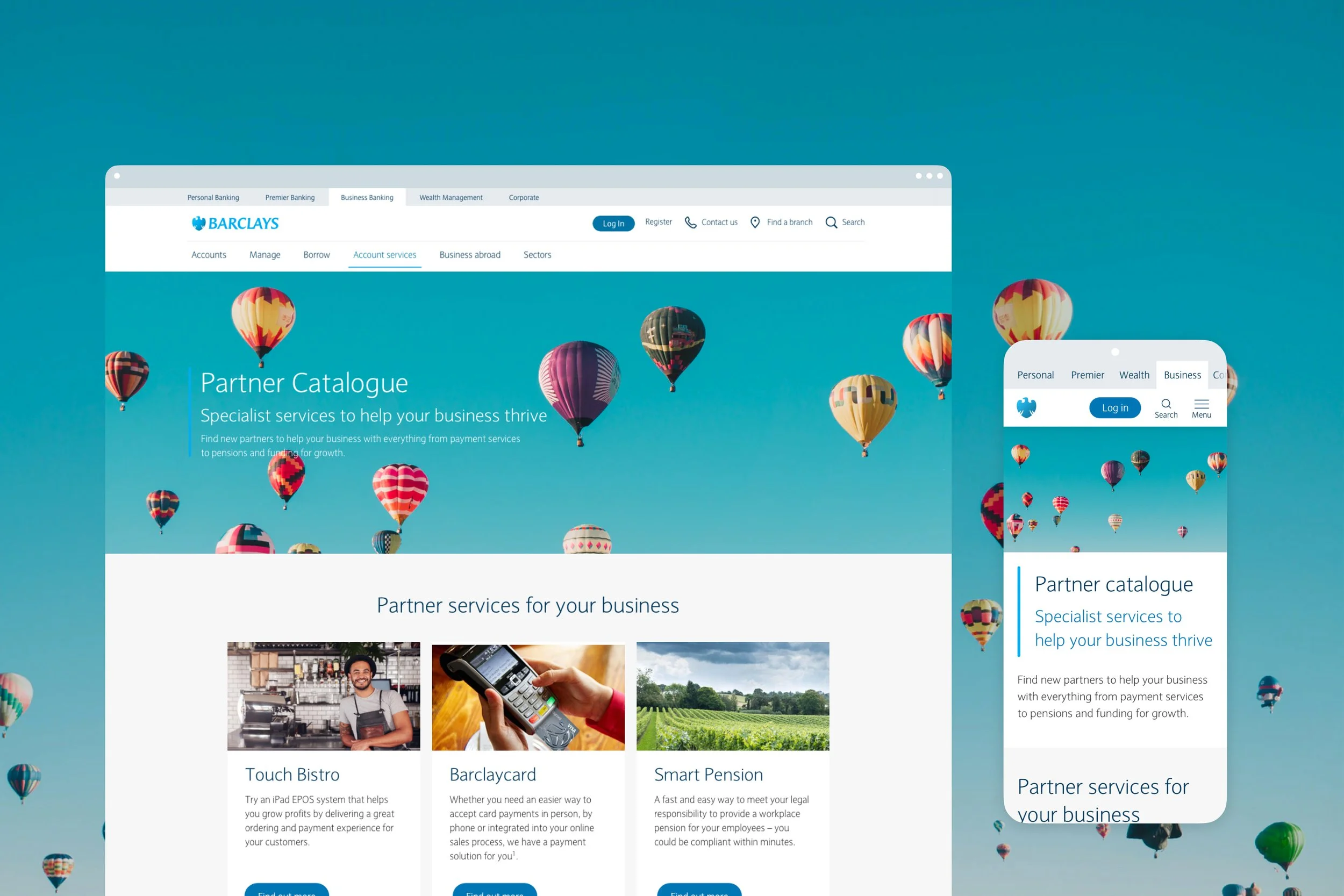
Barclays Business Marketplace
Designing a partner marketplace across Barclays’ business channels, anchored in trust and convenience.
UX & UI Design
2019
Sennep

Context
Barclays were exploring a new partner marketplace for business customers. The commercial model was in place, but there was no clear view of how it should behave across channels or how it should show up in core banking journeys without feeling promotional.
Chalenge
The challenge was to articulate the vision and turn a commercial concept into clear, executable customer journeys across Barclays channels.
Discovery
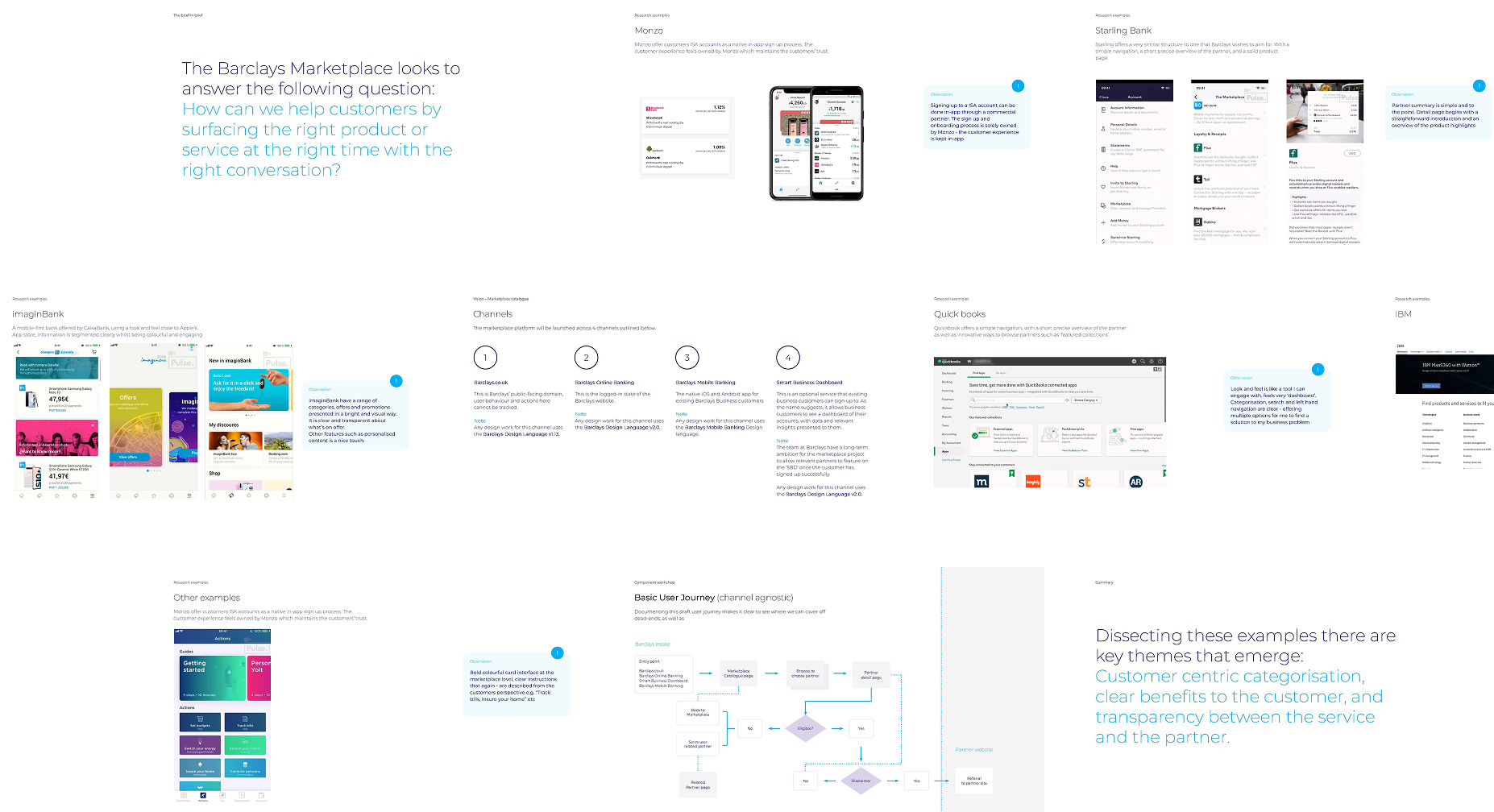
Market & Adjacent Research
We reviewed comparable partner-led platforms to identify patterns in categorisation, clarity of benefit, and transparency between platform and partner.
We used these themes to inform direction, then ran stakeholder interviews with Barclays’ commercial relationship owners to understand constraints, expectations and partner requirements.
Discovery
Naming exploration
As the concept developed, it became clear the proposition name needed work. We explored a set of naming directions to test further, aiming for language that felt clear, credible, and non-promotional.
Curated partners
Marketplace
Barclays marketplace
Our partnerships
Connected services
Partner services


Strategic Direction
The Marketplace was designed as a single, channel-agnostic system across public, logged-in, app and dashboard environments.
With no discounts available, it couldn’t rely on visibility to create value, so we anchored it in trust and convenience: Barclays’ endorsement plus curated partner services surfaced in the right context.
Trust &
convenience
Navigation
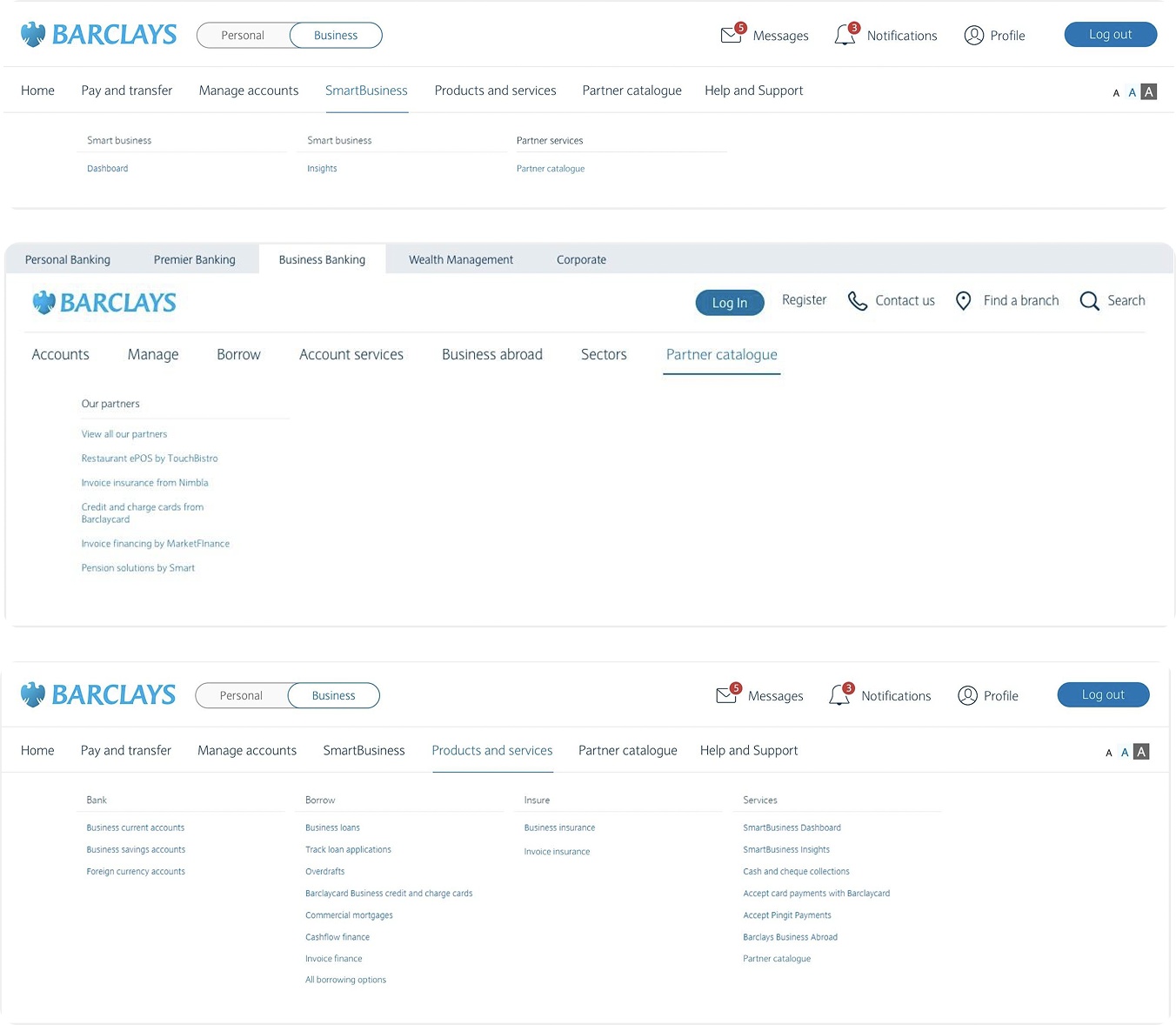
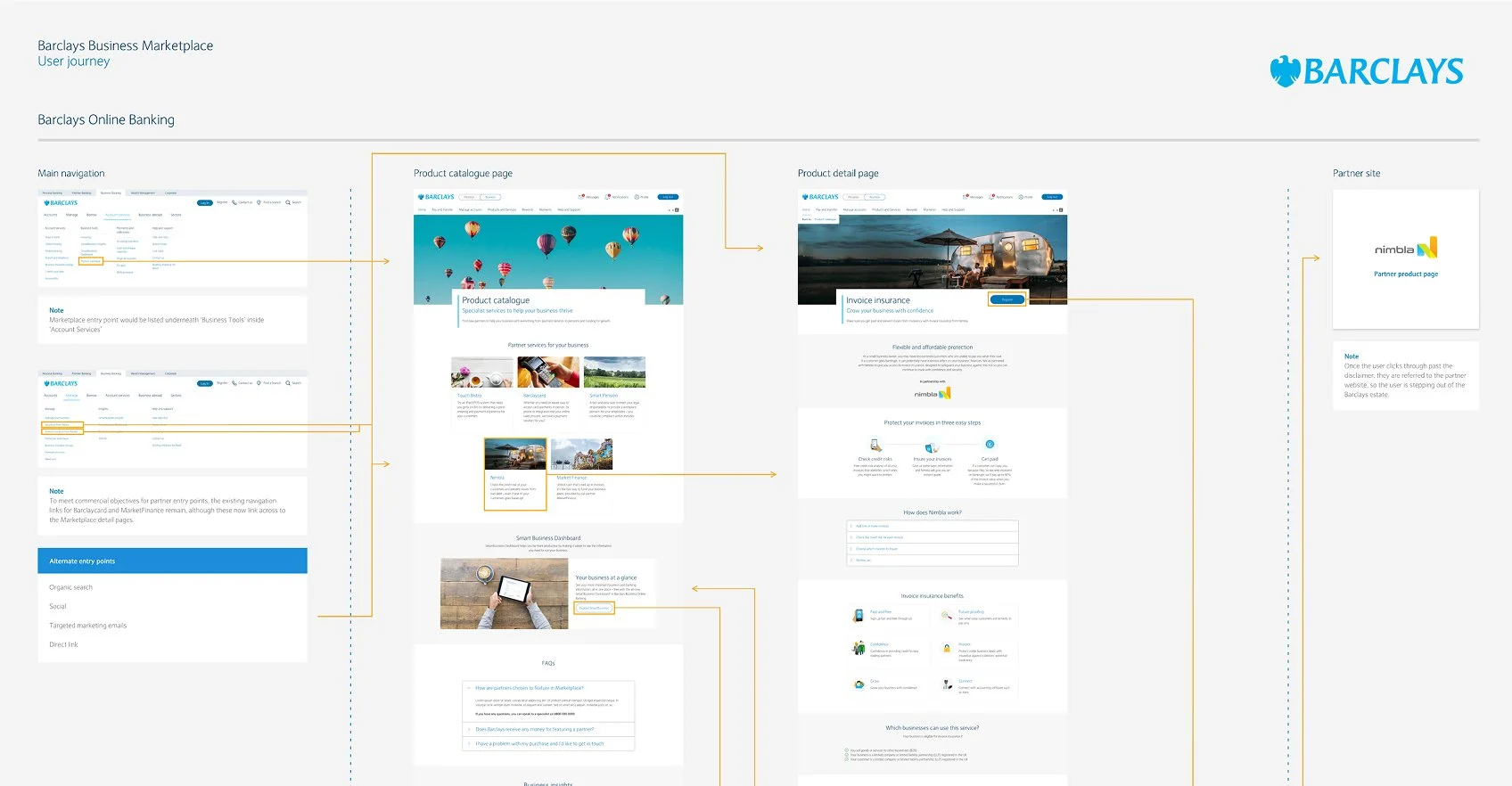
Mapping the marketplace location in the main navigation was key to ensure that this new commercial concept slotted into the existing IA framework, and showed up where users expected it to - as an assistive function, not an unexpected sales opportunity. This mapping exercise provided the Barclays team guidance to lock in the correct IA with multiple connected teams and product owners across channels.
Design
Designing for four separate launch channels
Once the design phase was underway, we needed to adapt our thinking to work across channels and user entry points ready for launch.
1 - Barclays.co.uk
Explain what Marketplace is and why it’s worth using to build confidence before a business customer signs in.
2 - Business Online Banking
Make it easy to discover without getting in the way, Ideally Marketplace would sit in assistance to core banking tasks not just as a “browse” destination.
3 - Smart Business Dashboard
This is Barclays’ proprietary online analytical dashboard for Businesses. So we aimed for Marketplace to have a more utilitarian lens to offer contextual recommendations, alongside users’ ability to analyse business performance.
4 - Mobile App
A ‘lighter’ experience than other channels, in order to keep information contextual to a native app experience; fast access, minimal reading, and no disruption to primary actions.
User Experience Design
User flow mapping
We mapped user flows from discovery to partner selection and handoff, from core navigational entry points. This served as the architecture across three key channels; Barclays.co.uk, Online Banking and the Barclays App.
User Experience Design
Task flow & Requirements:
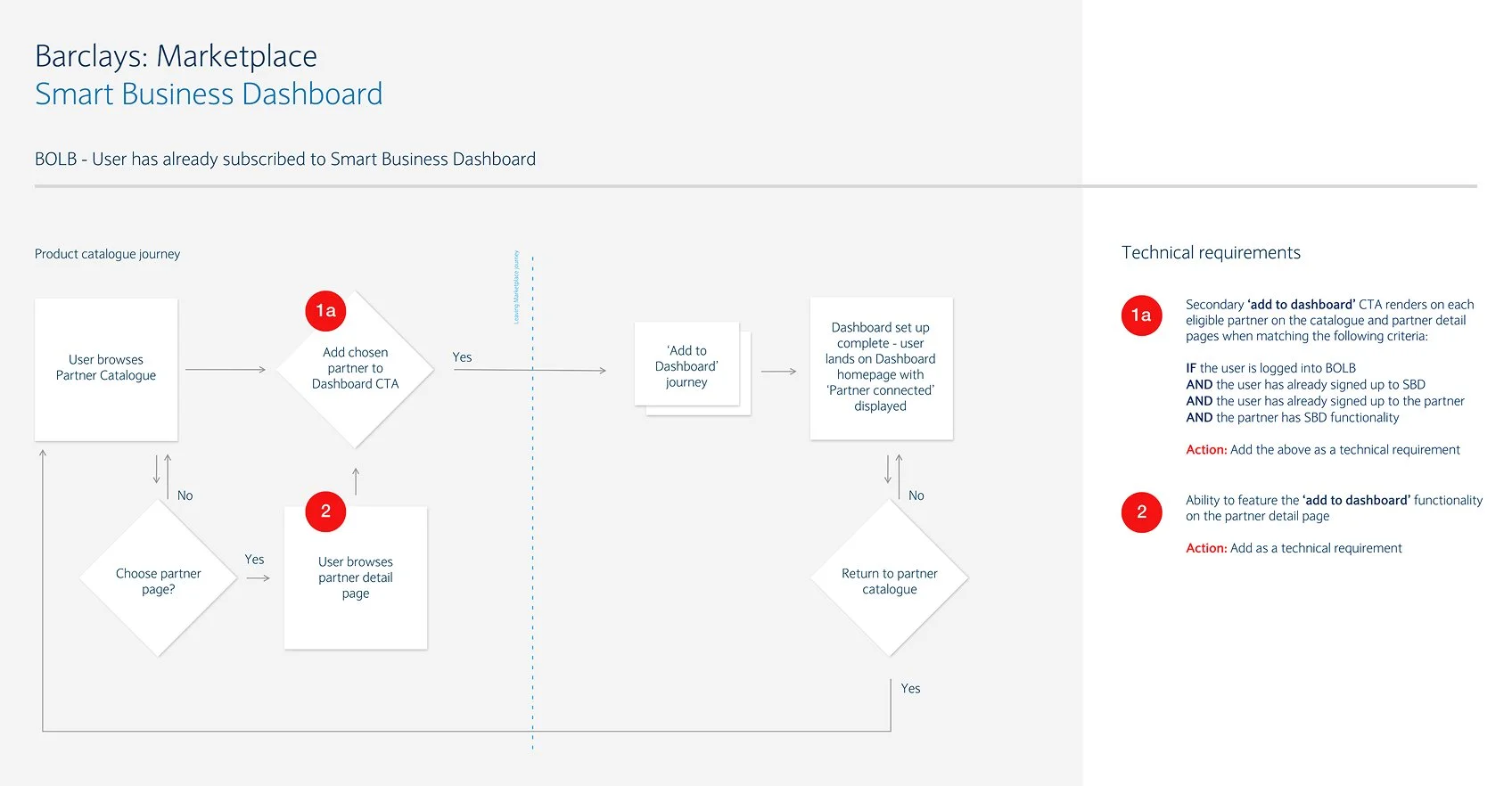
‘Smart Business Dashboard'
Smart Business Dashboard provided its own challenge which needed foundational thinking in how users added partners to their dashboard space. Our work and logical dependecy thinking here enabled the wider Barclays team to assess complexity and spin this into its own ‘phase 2’ project after public launch on the core channels.
Content Design
Wireframe development
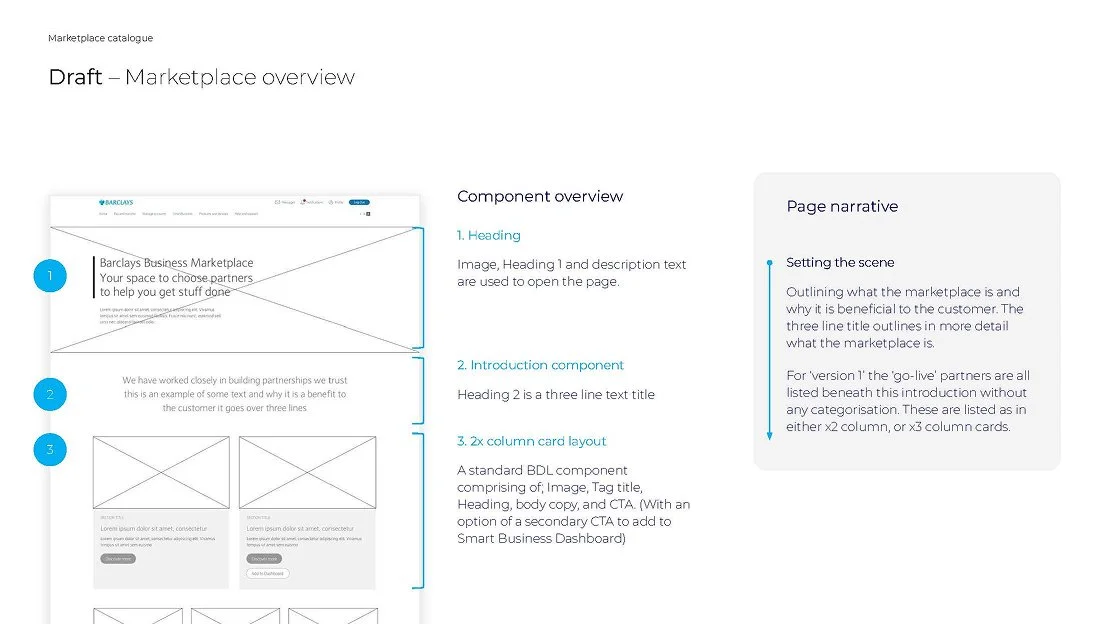
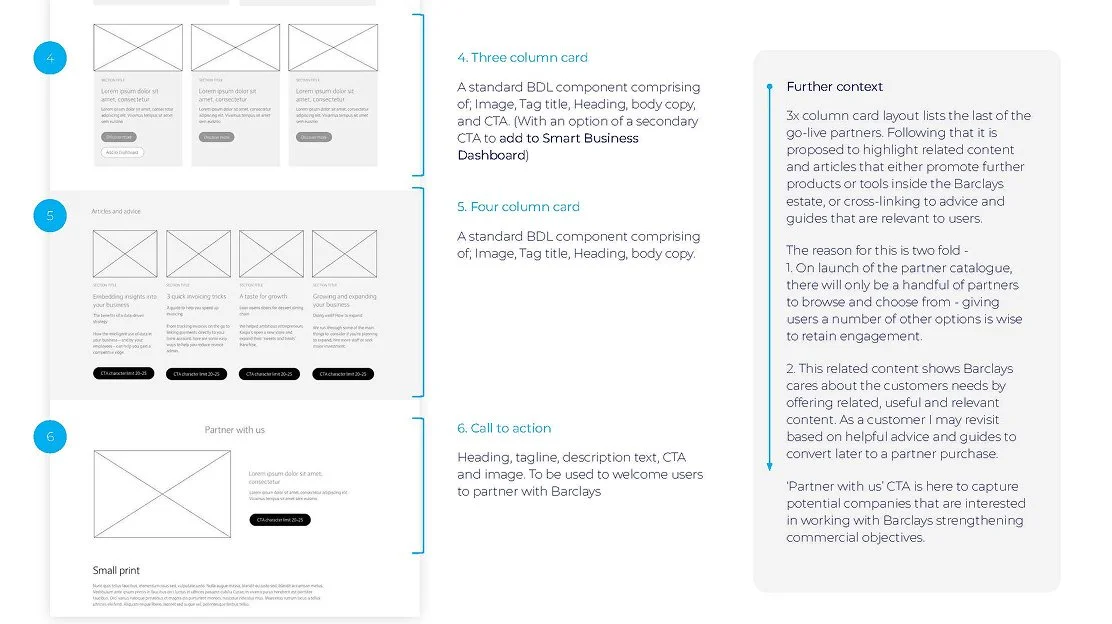
We developed partner-specific wireframes to apply the templates in practice, covering catalogue, partner pages and handoff states for the initial launch partners.
Content Design
Standardised partner pages
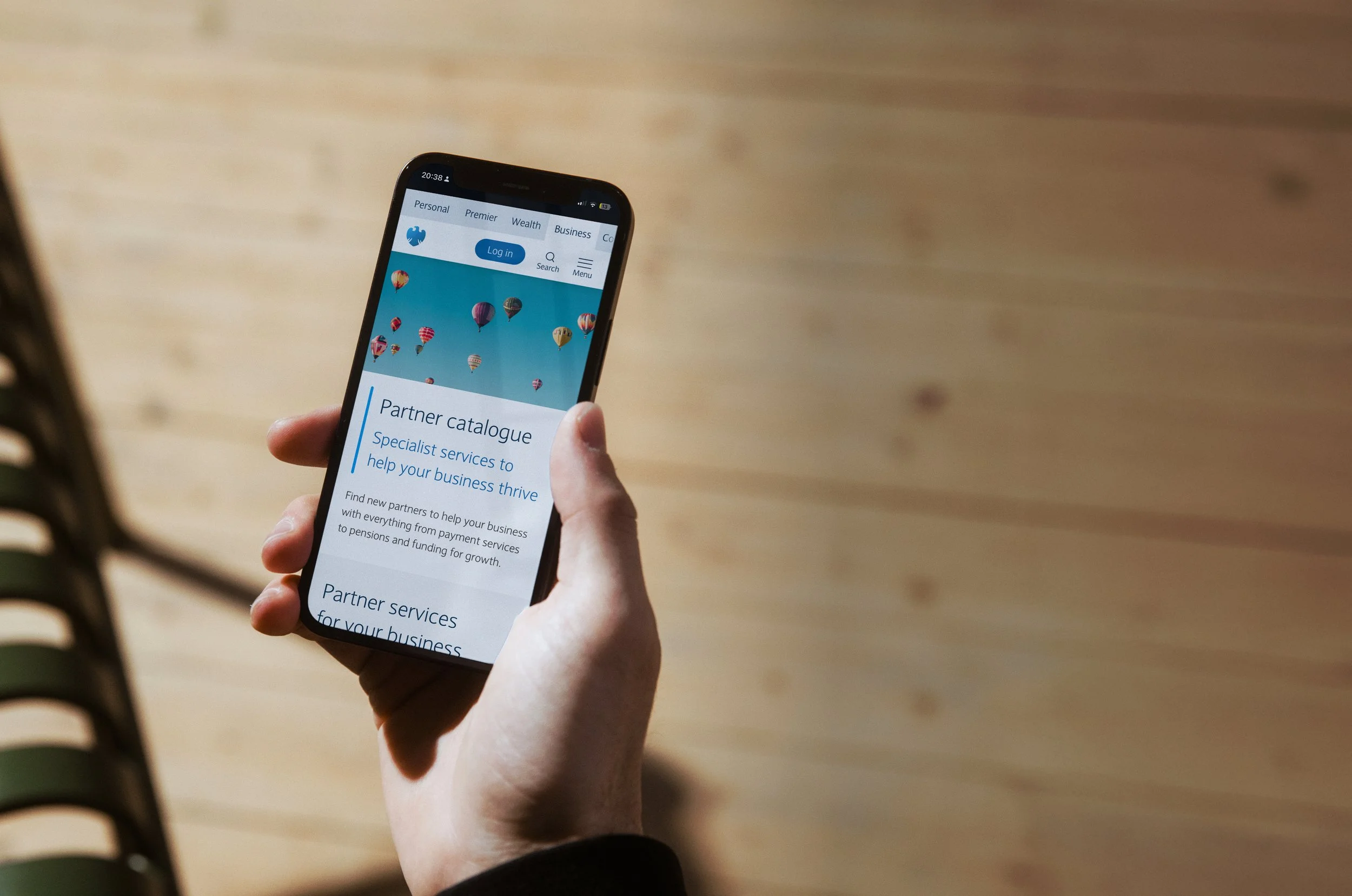
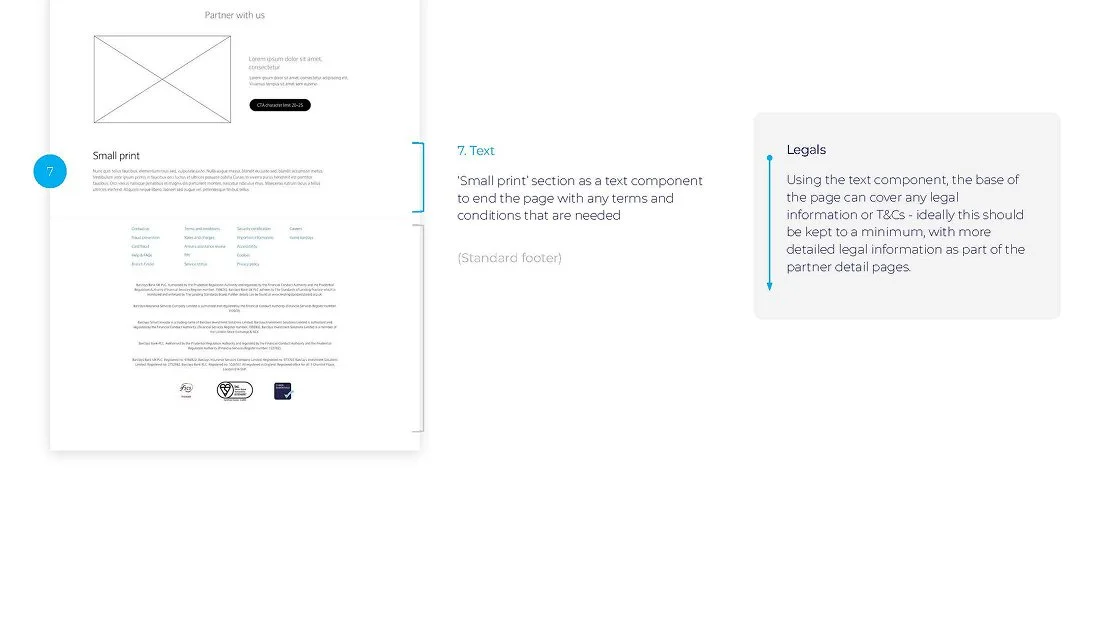
We created a repeatable partner page template using Barclays’ design system, so every service was presented consistently and the framework could scale to new partners without redesigning from scratch.
Page content flow
This was the baseline structure for every partner page.
Introduce the product
Describe how it works
Outline key service benefits
Provide action and alternate options
Design
Leading stakeholder alignment
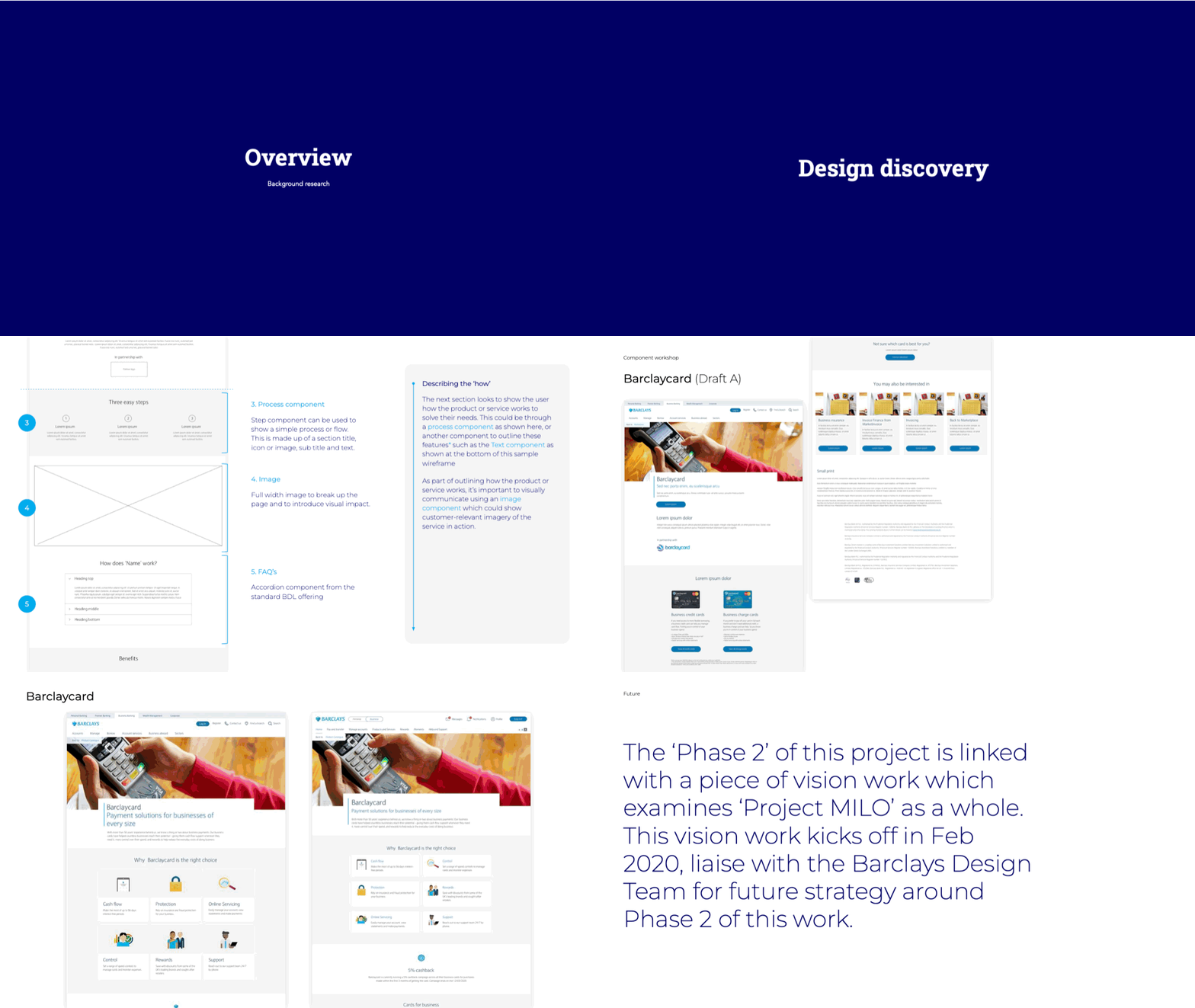
This project was less about Figma and more about meetings. I kept stakeholders aligned, captured decisions as we made them, and turned messy input into something teams could build from. The deck became the working reference for flows, templates and rationale, so the project could move forward with confidence
Design
Outcome
A channel-agnostic Marketplace framework, applied across web and mobile. Built around consistent templates, clear partner narratives, and a scalable approach to categorisation.